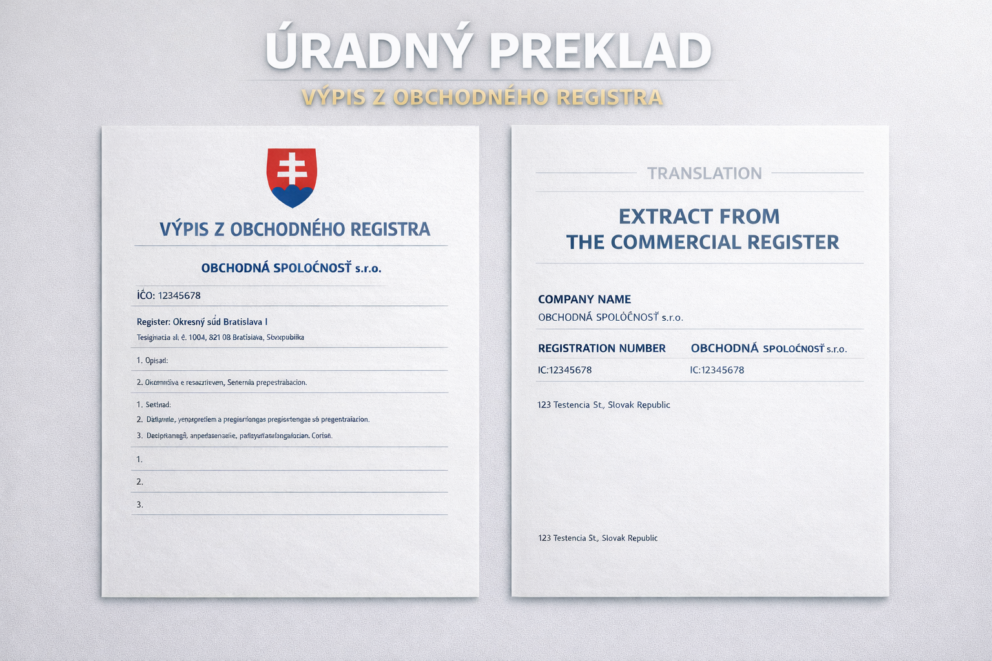
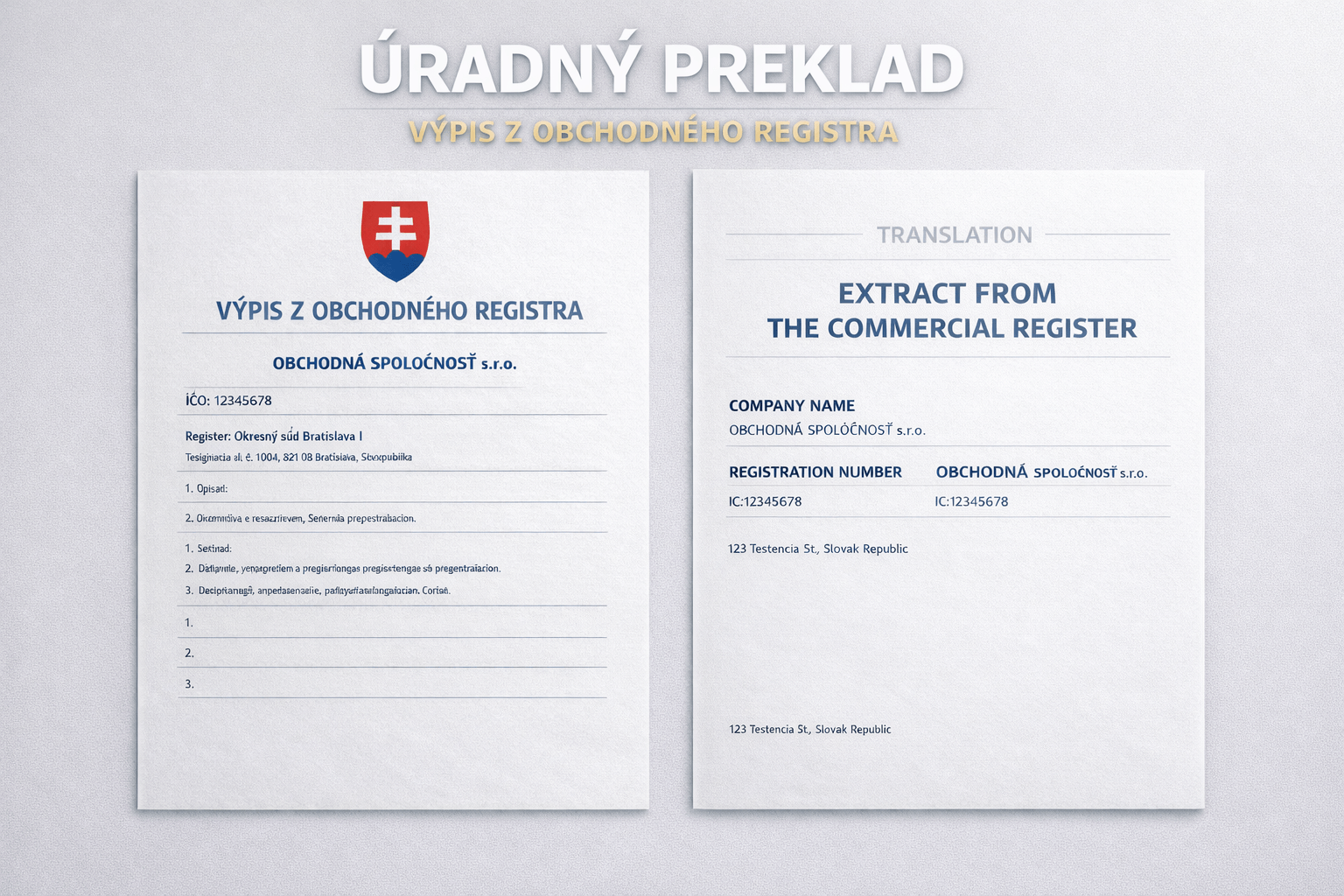
An apostille is a term you will encounter whenever you need to use a Slovak public document abroad. This may involve Commercial Register Extracts, powers of attorney, residence permits, or personal documents such as diplomas, birth certificates, and criminal record extracts. Without an apostille, a foreign authority may refuse to accept them. This guide explains what an apostille is, when it is required, and why it pays to understand the exceptions.
What Is an Apostille and Why Is It Used?
An apostille is an internationally recognised certification of the authenticity of a document. It is a clause issued under the Hague Convention of 1961, which simplifies the use of public documents between member countries. Instead of a lengthy superlegalization process — that is, multiple rounds of document verification — a single apostille is sufficient. Slovakia has been issuing apostilles since 2002.
In practical terms, an apostille confirms that the signature, stamp, or seal on a document is genuine. As a result, the document can be recognised abroad without any further verification.
What Does an Apostille Look Like?
An apostille is most commonly a separate sheet of paper, large stamp or sticker attached or affixed to the original document. It contains 10 standardised fields, including the country of issue, the name and capacity of the person who signed the document, and the exact date of issue.
In Slovakia, apostilles are issued in a Slovak and partially in English, which makes them easier to use abroad.
Who Issues the Apostille?
In Slovakia, there is no single authority responsible for apostilling all types of documents. The issuing body depends on the type of document being verified:
- Regional Courts (Krajské súdy)
- Ministry of the Interior of the Slovak Republic
- Ministry of Education of the Slovak Republic
- Ministry of Foreign Affairs of the Slovak Republic
Where to Obtain an Apostille for Common Documents
In Slovakia, apostilles are always issued by the state authority that has jurisdiction over the type of document being verified. Below are examples of the most common documents and the institutions responsible for their apostille.
| Document type | Responsible authority |
|---|---|
| Proof of citizenship | Ministry of the Interior |
| Identity document | Authenticated by a notary; apostilled by the Ministry of the Interior |
| Medical report | Ministry of Health |
| Court or bailiff document | Regional Court |
| Birth certificate, marriage certificate, death certificate | District Office (Okresný úrad) |
| Power of attorney, affidavit, contract | Authenticated by a notary; apostilled by the Regional Court |
| Residence permit for foreign nationals | Consular Department of the Ministry of Foreign Affairs |
| Confirmation of permanent or temporary residence for Slovak citizens | District Office |
| Land Registry Extract for use abroad | Consular Department of the Ministry of Foreign Affairs |
| Commercial Register Extract | Regional Court |
| Criminal record extract, Land Registry Extract | Ministry of Foreign Affairs |
| School certificate or diploma | Ministry of Education |
| Expert report, sworn translation, notarial deed | Regional Court |
When You Do Not Need an Apostille
Although apostilles are frequently required, there are countries with which Slovakia has bilateral agreements. In these cases, public documents are recognised between the two countries without an apostille. This often applies to neighbouring or EU member states, such as the Czech Republic, Hungary, Austria, France, Belgium, Italy, and Poland.
Important: Even where a bilateral agreement exists, always confirm with the receiving authority in advance whether the document will be accepted without an apostille. In practice, some authorities may insist on an apostille regardless of any international agreement.
Does the Apostille Need to Be Sworn Translated?
Yes. An apostille is issued in the official language of the state that issued the underlying document. Therefore, if you intend to use the document with its apostille abroad, you will need a sworn translation of both the document and the apostille. This means you should first obtain the apostille and only then send the document for translation. In this case, the apostille is treated as part of the document and is translated together with it.
How to Obtain an Apostille: A Step-by-Step Example
To illustrate the entire process, here is a practical example — obtaining an apostille for a power of attorney issued in Bratislava:
- You prepare and sign the power of attorney before a notary in Bratislava. The notary authenticates it with their signature and stamp.
- You take the authenticated document to the relevant Regional Court (for example, the Regional Court in Bratislava), which issues an apostille confirming the authenticity of the notary’s authentication.
- You then submit the apostilled power of attorney to a sworn translator or a translation agency, which prepares a sworn translation of both the power of attorney and the apostille.
- If the foreign authority requires it, a second apostille can be issued — this time to verify the signature and stamp of the sworn translator. This apostille is also issued by the Regional Court.
- The result is a document that is both sworn translated and apostilled, and therefore fully valid for use abroad without any further verification.
To have an apostille issued, you need to submit a request, the original document to be apostilled, and pay the applicable administrative fee.
The standard fee for apostilling a single document in Slovakia is €10, regardless of the number of pages. The fee can be paid in cash at the relevant office, via an electronic stamp purchased online, at a kiosk at the office, or by purchasing a stamp at a Slovak Post branch.
How We Can Help
At Otago, we provide sworn translations of documents with apostilles into more than 60 languages. We make sure that every translation is accurate in both legal and factual terms. If you are not sure whether you need an apostille, the best approach is to check with the authority where you will be submitting the document. Alternatively, get in touch and we will do our best to advise you.
Frequently Asked Questions About Apostilles
When do I need an apostille?
You need an apostille whenever you plan to use a Slovak public document abroad, in a country that is a signatory to the Hague Convention of 1961. Without it, the document may not be recognised.
Does the apostille need to be translated?
Yes. An apostille is usually issued in the official language of the country that issued the document. It must therefore be sworn translated along with the document itself.
Can I obtain an apostille online?
Some offices allow you to purchase the administrative stamp electronically. However, the apostille itself is issued in person, in paper form.
How much does an apostille cost?
In Slovakia, the administrative fee is €10 per document, regardless of the number of pages.
What does an apostille look like?
An apostille is a separate sheet attached to the document. It contains 10 standardised fields, including the country of issue, the name and capacity of the signatory, and the date of issue. In Slovakia, it is bilingual — in Slovak and English.
Does the apostille need to be sworn translated?
Yes. If you are submitting the document abroad in a country where Slovak is not spoken, a sworn translation of the apostille is required as part of the overall sworn translation.
Do I need an apostille within the EU?
In most cases, no — provided Slovakia has a bilateral agreement with the country in question. Even so, it is advisable to confirm the requirements with the relevant authority in advance.
What is the difference between an apostille and superlegalization?
An apostille simplifies the legalisation of documents between countries that are party to the Hague Convention. Superlegalization is a more complex process required for countries outside this framework.
Where do I obtain an apostille?
You obtain the apostille from the relevant authority based on the type of document. For example, notarial deeds and sworn translations are apostilled by the Regional Court, while registry documents are handled by the District Office.